CFD Validation for Building Aerodynamics and Wind Environment
This case study investigated external aerodynamics and wind environment around a structure using computational fluid dynamics. The analysis demonstrated the application of RANS models for qualitative flow prediction and a methodology for assessing pedestrian-level comfort.
Project Overview
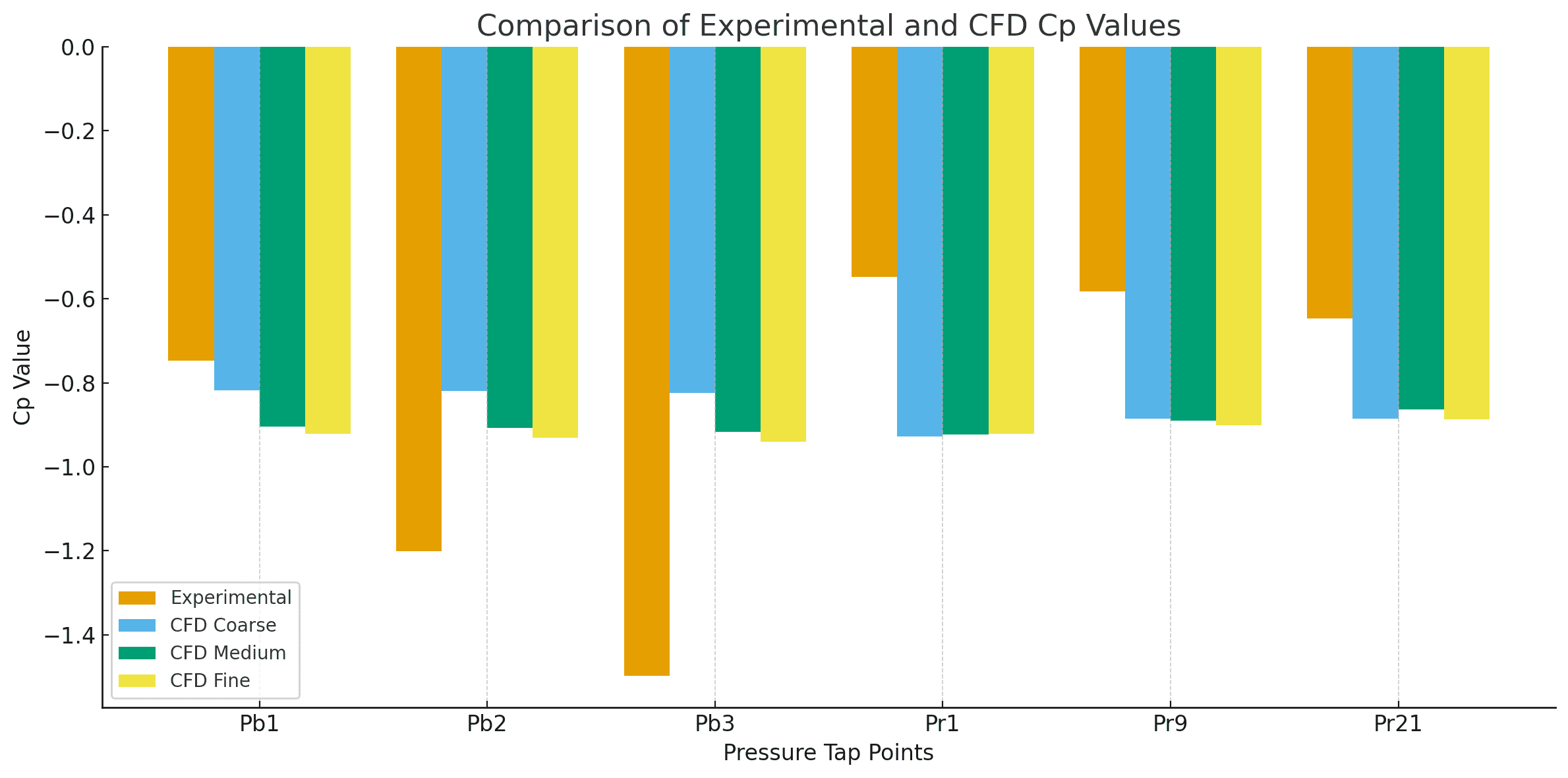
This project involved a comprehensive computational fluid dynamics (CFD) analysis to evaluate external aerodynamic loads and local wind conditions around a representative structure. Utilizing a Reynolds-averaged Navier-Stokes (RANS) turbulence model, the study focused on predicting surface pressure distributions and pedestrian-level wind speeds under atmospheric boundary layer inflow. A rigorous validation process compared CFD results against experimental wind tunnel data, highlighting the model's ability to capture qualitative flow features and spatial trends while discussing quantitative deviations in complex separated regions. Furthermore, a detailed grid convergence study was performed to ensure solution independence from mesh resolution. The work also developed and applied a robust scaling methodology to translate model-scale CFD velocities into full-scale pedestrian comfort assessments, demonstrating a complete workflow for urban wind environment analysis.
Need a similar simulation?
Get a fixed-price quote within 24 hours.