Crashworthiness Analysis of Additively Manufactured Lattice-Reinforced Automotive Bumpers
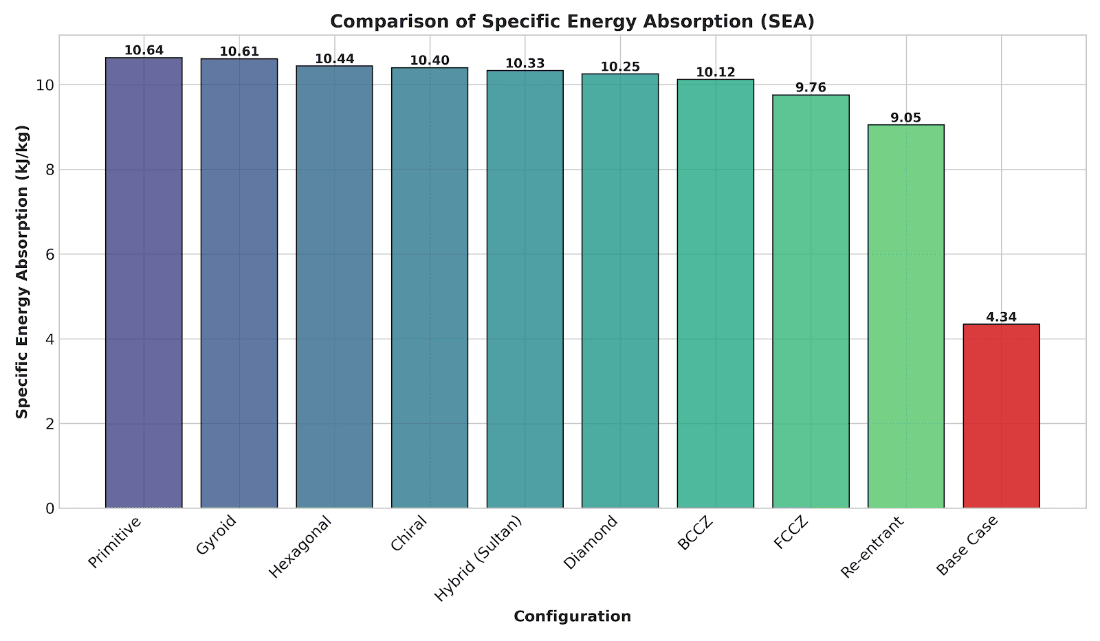
This study numerically benchmarked advanced automotive bumper systems integrated with additively manufacturable lattice cores under frontal crash scenarios. Results quantified topology-dependent trade-offs, demonstrating that BCCZ lattices reduced peak force by 71% while Hybrid lattices increased energy absorption by 256%.

Project Overview
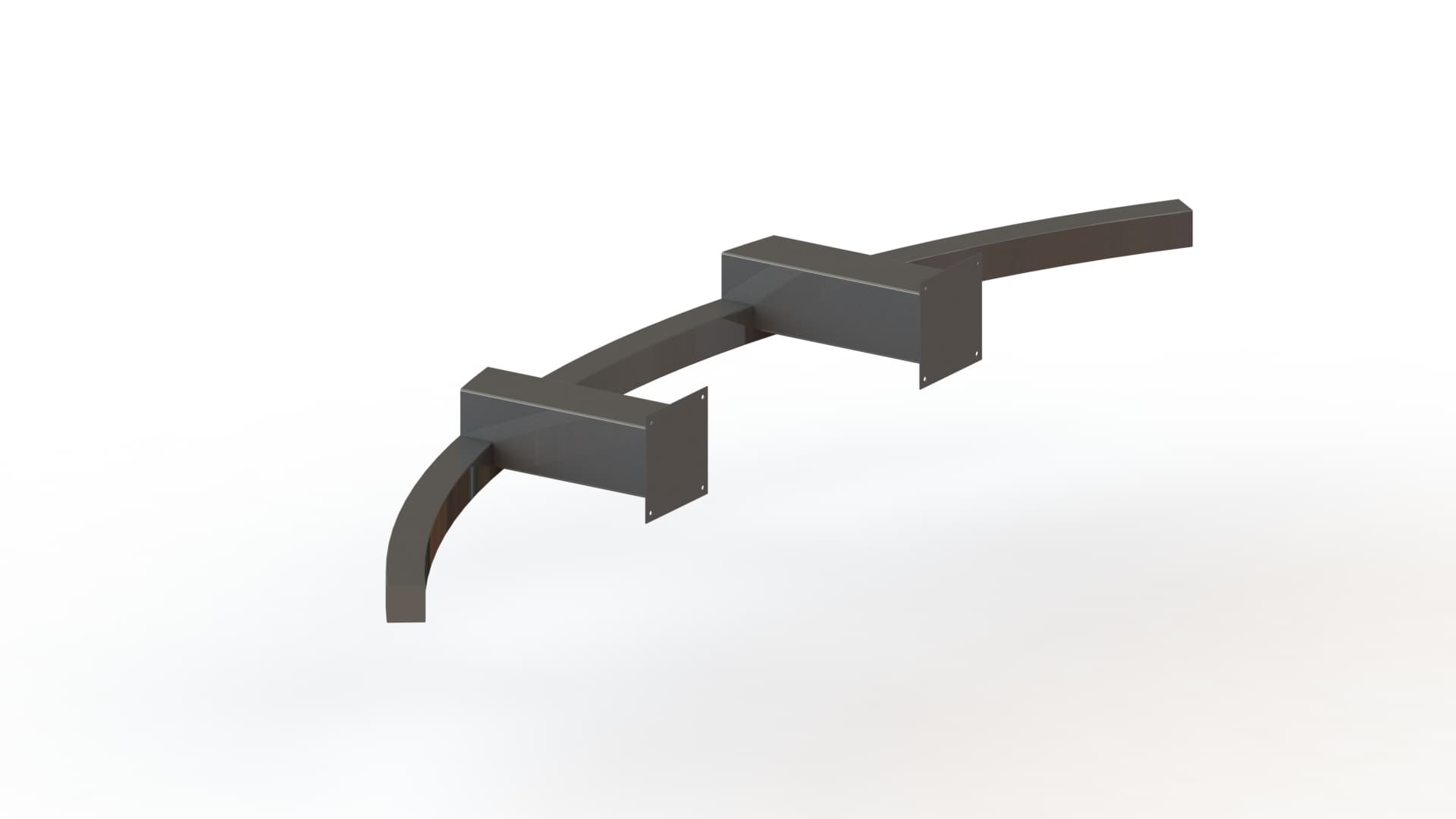
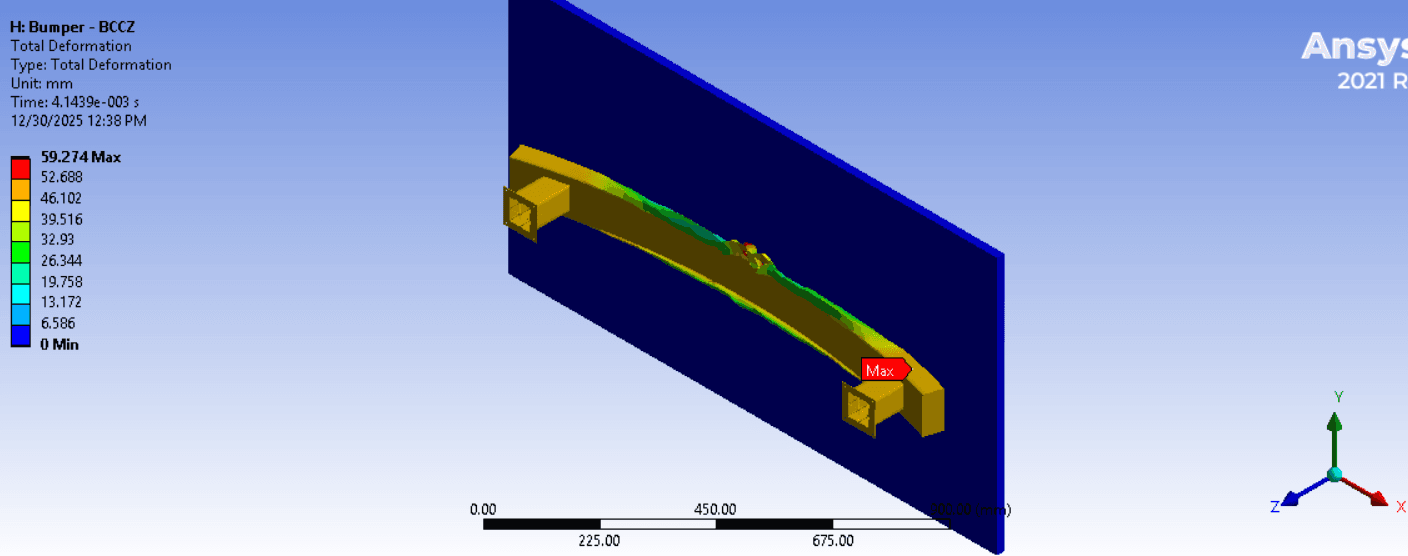
Automotive front-end structures require efficient collision energy dissipation while strictly limiting peak impact forces for occupant safety. Conventional bumper beams often exhibit catastrophic buckling and inefficient load distribution. This project performed a comprehensive numerical benchmark of advanced automotive bumper systems integrated with additively manufacturable lattice cores. Utilizing explicit finite element analysis (LS-DYNA), a baseline hollow bumper's crashworthiness was compared against eight distinct lattice-reinforced variants, including strut-based, TPMS, and complex architectures, under a 15.5 m/s frontal crash. Key performance indicators like Peak Crushing Force (PCF) and Specific Energy Absorption (SEA) were extracted. Results revealed that lattice topology critically dictates crash response. The BCCZ lattice reduced peak crushing force by 71% for occupant safety, while the Hybrid lattice increased total absorbed energy by 256% for heavy-duty applications. Primitive and Gyroid TPMS structures offered superior mass efficiency, validating their potential for lightweight electric vehicle platforms and providing a robust design framework for next-generation crashworthy systems.
Results


Need a similar simulation?
Get a fixed-price quote within 24 hours.